May Product Updates
In May, NineData continued to improve AI Agent capabilities, cloud-based slow query governance, OpenAPI coverage, SQL intelligent optimization, and data source adaptation. This release includes 17 updates across Database DevOps, AI Agent, and Data Replication, helping teams bring performance diagnosis, SQL optimization, automation, and multi-cloud operations into one platform.
Highlights
AI Agent: ChatDBA Moves from Q&A Toward Actionable Diagnosis
In May, ChatDBA continued to evolve from a knowledge Q&A assistant into a database-aware diagnostic assistant that can understand data source context and support more actionable workflows.
- ChatDBA now supports data source access, allowing answers and analysis to use the context of the selected database.
- Database DevOps now supports ChatDBA-powered database performance diagnosis, helping teams investigate instances, sessions, slow SQL, and related operational issues.
- A new SQL execution Skill is available, with support for SQL execution through OpenAPI calls.
- Text2SQL is now integrated into ChatDBA conversations, allowing users to generate SQL from natural language during a chat.
- Cross-session retrieval memory has been added, while knowledge base retrieval trees and memory usage for large documents have been optimized.
- ER diagram generation performance and accuracy have been improved, and the data source context issue after switching data sources in a ChatDBA conversation has been fixed.
These updates make ChatDBA more than a place to ask questions. It is becoming an AI database assistant that can understand the database context, call tools, and suggest practical next steps.
Database DevOps: Slow Query Analysis Covers More Cloud Vendors and Collection Methods
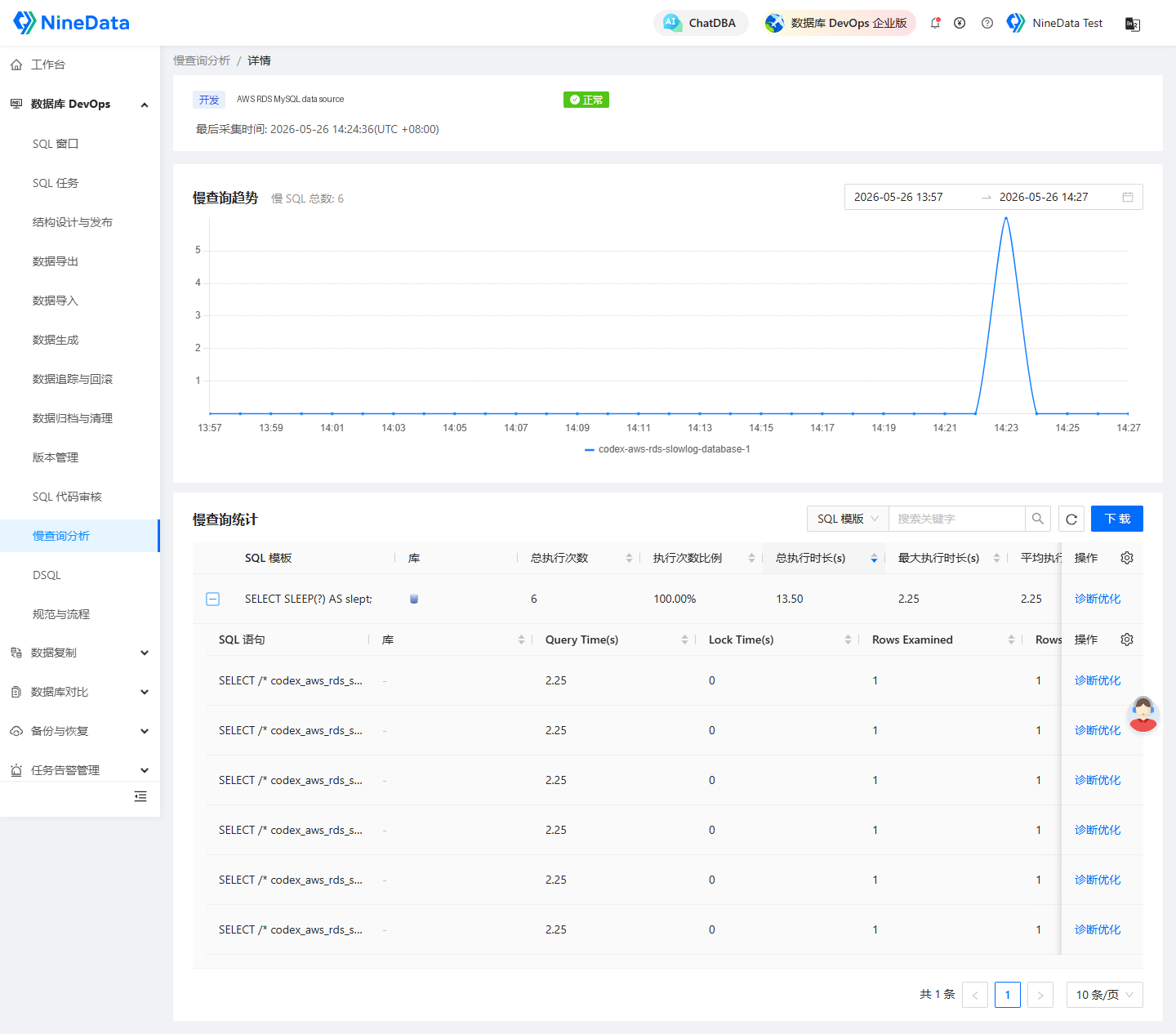
Slow query governance continued to expand in May:
- External slow log collection sources now support Huawei Cloud and AWS.
- Slow query analysis now supports AWS RDS MySQL and AWS RDS PostgreSQL.
- Alibaba Cloud SQL Server slow logs now support OpenAPI collection.
- Slow log OpenAPI collection now supports Tencent Cloud RDS MySQL, Tencent Cloud RDS PostgreSQL, and Tencent Cloud TDSQL.
- PostgreSQL slow query ingestion has been optimized to avoid transaction-size issues when writing a large volume of slow query records to the metadata database.
For teams running databases across multiple cloud vendors or using centralized log collection systems, NineData can now bring more slow log sources into one place for analysis and governance.
Database DevOps: OpenAPI Coverage Expands to Security Rules and Approval Flows
This month, NineData added OpenAPI support for security rules and approval flows.
Teams can now connect rule configuration, approval processes, and internal automation platforms more closely. For example, they can synchronize security rules, create approval flows, or integrate database change review and approval into existing internal systems.
Slow log OpenAPI collection also expanded across more cloud vendors, making slow query analysis easier to integrate into platform-level automation instead of relying only on manual page configuration.
SQL Intelligent Optimization and SQL Console Continue to Expand
SQL intelligent optimization now supports MySQL-compatible databases and has expanded to Oracle, SQL Server, and more data sources. This gives developers and DBAs SQL analysis, index recommendations, and rewrite suggestions across a wider range of heterogeneous database environments.
In SQL Console, YashanDB is now supported, and its SQL Console adaptation has also been improved. This further expands NineData coverage for domestic database development and operations scenarios.
Data Source Management and Sensitive Data Protection Improvements
May also added several improvements across data source onboarding and data security workflows:
- Greenplum data source onboarding now includes a default database.
- Sensitive data scanning now supports MariaDB.
- Sensitive column scanning now supports Greenplum.
- Fixed an issue where MD5 and AES algorithms did not take effect in data masking scenarios.
- Fixed an issue where MariaDB data export could fail when sensitive columns were involved.
These updates make data source access, sensitive data discovery, masking, and export workflows more complete for teams managing multiple database types.
Improvements
Data Replication: Redis and DB2 Stability Improvements
- Redis full replication specifications can now set CPU and memory based on user selection.
- Fixed an issue where Redis distributed cluster full replication tasks could not be paused.
- Fixed the startTime update logic for Redis primary tasks.
- Fixed an issue where Redis cluster child nodes could show invalid non-zero databases when the returned database count was not 1.
- Fixed a DB2 data inconsistency issue when writing special characters.
- Fixed an exception when writing empty Blob values to DB2.
Database DevOps: Multi-Data-Source Compatibility Fixes
- Fixed ADB-PG temporary table SQL execution and statement splitting issues.
- Fixed an error when viewing DDL statements in TDSQL.
- Adjusted GaussDB distributed JDBC parameters to resolve query errors.
- Fixed a three-level permission issue in SQL Server SQL tasks.
- Fixed a Kingbase time zone issue.
- Fixed constraint and index name conflicts when archiving SQL Server data into the same schema.
Closing
May's updates follow a clear direction: AI Agent and SQL intelligent optimization are becoming more embedded in daily database work, while slow query analysis, OpenAPI, data source adaptation, and replication stability continue to expand across multi-cloud and multi-database scenarios.
NineData will continue to make database development, operations, migration, synchronization, and performance governance more visible, more automated, and easier to put into practice.